
Will Keith Kellogg
Industrialist who founded Kellogg Company and Kellogg Foundation.

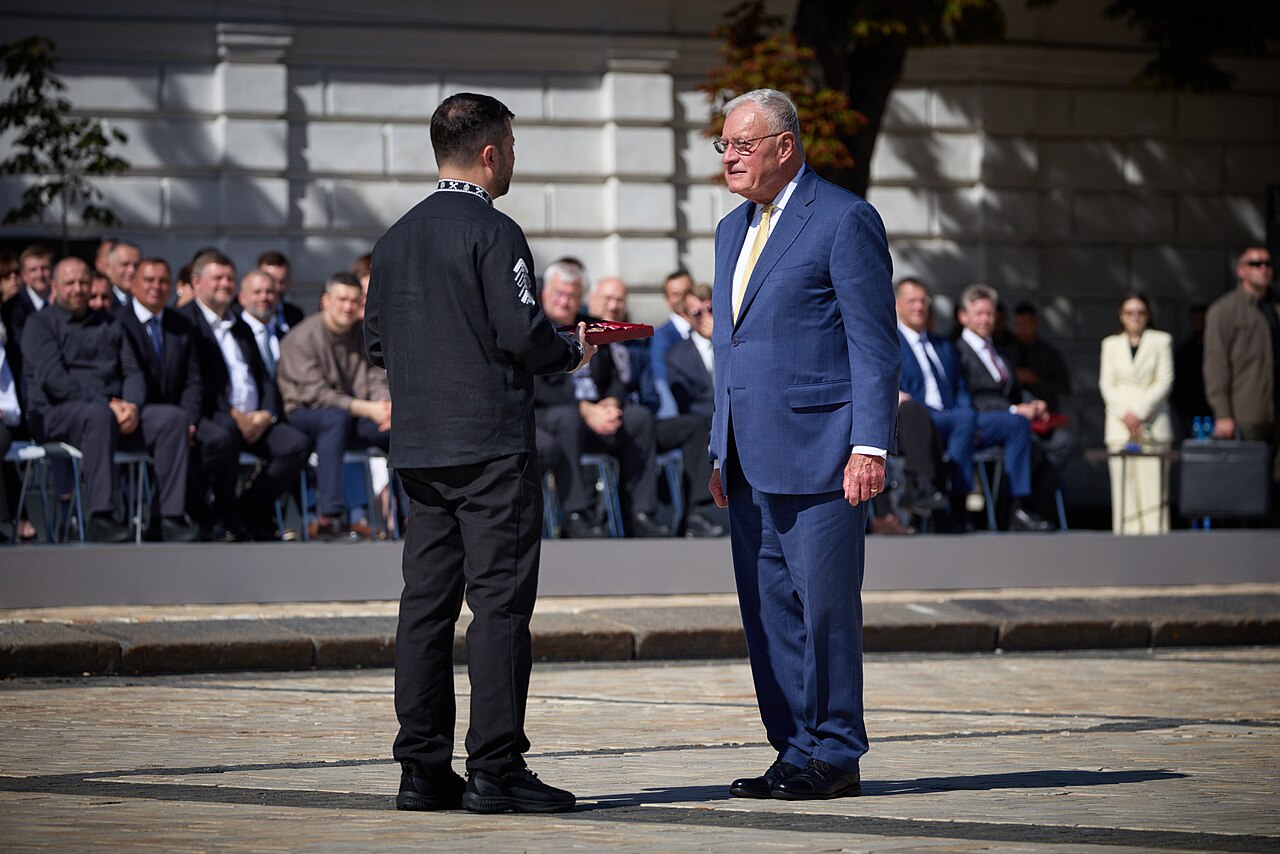
U.S. Embassy Kyiv Ukraine · Public domain
- field
- Food manufacturing, philanthropy
- nationality
- American
- known_for
- Founding the Kellogg Company; pioneering flaked cereal; establishing the Kellogg Foundation
Lore & Background
The Kelloggs pioneered the process of making flaked cereal; W.K. wanted the process kept secret, but John allowed observation, leading C. W. and prompted him to leave the sanitarium and create his own company. Together with his brother, W.K. promoted cereals, especially corn flakes, as a healthy breakfast food. The brothers argued over adding sugar, with W.K. in favor and John opposed. His company was one of the first to put nutrition labels on foods and offered the first inside-the-box prize for children. Kellogg had a longtime interest in Arabian horses. The ranch held weekly public horse exhibitions attended by Hollywood celebrities. During World War II, it was taken over by the U.S. War Department.
Reader's Guide
Will Keith Kellogg's significance lies in his transformation of breakfast habits through mass-produced flaked cereals, particularly corn flakes, which shifted the American breakfast from heavy meat-and-egg meals to lighter, grain-based options. His founding of the Kellogg Company established a global brand that pioneered marketing innovations such as nutrition labels and cereal box prizes. His philanthropic legacy is substantial: the W. K. Kellogg's life illustrates the intersection of religious dietary principles, industrial innovation, and large-scale philanthropy.
Did You Know?
- Kellogg started his career selling brooms in Battle Creek, Michigan.
- His company offered the first inside-the-box prize for children.
A Neighborhood of Power and Prestige
The Upper East Side occupies a distinctive place within Manhattan's borough structure, functioning as a neighborhood that has long served as a gathering point for individuals and families who hold considerable wealth, political power, and cultural influence on a global scale. This tradition of hosting the world's most prominent figures is not a recent development but rather a deeply rooted characteristic of the area. The concentration of notable residents spans multiple generations and multiple fields of endeavor, from business and politics to the arts and entertainment. The neighborhood's identity as a home for the powerful and influential is so well established that it forms the organizing principle around which its most famous inhabitants are catalogued. From the early twentieth century through the present day, the Upper East Side has maintained its reputation as a place where the most consequential figures in American and global life choose to reside, creating a community that is as much a social and economic institution as it is a geographic location within New York City.
The Astor Dynasty and Founding Families
The Astor family represents one of the most enduring dynasties associated with the Upper East Side, spanning multiple generations of business acumen, philanthropy, and public service. John Jacob Astor IV, who lived from 1864 to 1912, was a multifaceted figure: a businessman, real estate builder, investor, inventor, and writer who also served as a lieutenant colonel during the Spanish-American War. His life ended tragically as a passenger aboard the RMS Titanic, where he made the fateful choice to remain on the sinking vessel. His son Vincent Astor carried forward the family name as a businessman and philanthropist, while Caroline Schermerhorn Astor was known earlier as a socialite and her granddaughter Brooke Astor became a prominent philanthropist. Beyond the Astors, the neighborhood's early roster of notables included figures like Andrew Carnegie the industrialist, Henry Clay Frick the industrialist and art patron, and James Buchanan Duke the businessman, establishing a pattern of industrial-era wealth that defined the area's character for decades and set the template for subsequent generations of residents.
Financial Titans and the Business Elite
The Upper East Side has been a magnet for some of the most powerful figures in global finance and business. The roster of residents includes hedge fund managers such as Louis Bacon, Leon Black, James Dinan, Glenn Dubin, Israel Englander, and Karen Finerman, alongside bankers like Jules Bache, Michel David-Weill, Lloyd Blankfein, Jamie Dimon, and Richard S. Fuld Jr. The neighborhood has also been home to billionaires and major entrepreneurs, including Michael Bloomberg who served as mayor of New York City before becoming a billionaire philanthropist, Eli Broad the entrepreneur, and Charles Bronfman along with his sons Edgar and Matthew, all businessmen and philanthropists. The financial community is complemented by investors like Bernard Baruch, Joseph Baratta, and J. Christopher Flowers, as well as figures from diverse industries such as John DeLorean in the automobile sector, Amzi L. Barber in asphalt, and Edward Julius Berwind in coal mining. This concentration of financial and industrial power across centuries underscores the neighborhood's role as a nexus of economic influence.
Arts, Letters, and the Creative World
Beyond its business and political residents, the Upper East Side has been a home to a remarkable array of artists, writers, musicians, and performers who have shaped American and global culture. The literary world is represented by figures such as Truman Capote the novelist, Stephen Vincent Benét the poet, Joan Didion the author, Jonathan Franzen the National Book Award-winning novelist, and William F. Buckley Jr. the author. In the performing arts, the neighborhood has been associated with George M. Cohan the entertainer, playwright, and composer; Leonard Bernstein the composer and conductor; Plácido Domingo the tenor and conductor; and Yul Brynner the actor. The visual arts community includes Marc Chagall, George Condo, Walker Evans the photographer, and René Bouché the fashion illustrator. Cinema and television have drawn residents like Sean Connery, Mia Farrow, Lady Gaga, and Simon Cowell. This breadth of creative talent, spanning literature, music, visual art, and screen entertainment, demonstrates that the Upper East Side's influence extends far beyond commerce into the very fabric of cultural life.
Gallery
Frequently Asked Questions
What is Will Keith Kellogg's role in business history?
He is widely credited with pioneering flaked cereal and turning it into a mass-market commercial product through the Kellogg Company. His work fundamentally changed everyday breakfast habits for consumers around the world.
Why is Will Keith Kellogg important to the business world?
He transformed a simple flaked grain product into a global food-manufacturing empire, demonstrating how a single innovation could reshape an entire industry. His faith-driven commitment to vegetarian nutrition also set a distinctive ethical tone for his company's product philosophy.
More in Business Tycoons & Entrepreneurs 1-20
Related in Business Tycoons & Entrepreneurs
Links follow this subject's own source article.
Spotted an error? Know more?
This is a living reference — every entry is fact-audited, and reader corrections feed straight into our audit queue. Suggest an edit · See this site's audit record